
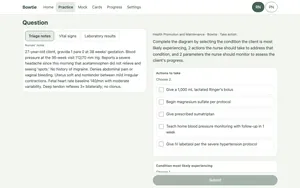
Triage notes
27-year-old client, gravida 1 para 0 at 38 weeks' gestation. Blood pressure at the 36-week visit 112/70 mm Hg. Reports a severe headache since this morning that acetaminophen did not relieve and seeing 'spots.' No history of migraine. Denies abdominal pain or vaginal bleeding. Uterus soft and nontender between mild irregular contractions. Fetal heart rate baseline 140/min with moderate variability. Deep tendon reflexes 3+ bilaterally; no clonus.
Vital signs
| Time | BP | HR | RR | SpO2 |
|---|---|---|---|---|
| 1410 | 164/112 mm Hg | 88/min | 18/min | 99% room air |
| 1425 | 166/110 mm Hg | 90/min | 18/min | 99% room air |
Laboratory results
| Test | Result | Reference |
|---|---|---|
| Urine protein/creatinine ratio | 0.4 mg/mg | below 0.3 mg/mg |
| Platelets | 180 × 10³/µL | 150–400 × 10³/µL |
| AST | 24 U/L | 0–35 U/L |
| ALT | 20 U/L | 4–36 U/L |
| Serum creatinine | 0.7 mg/dL | 0.5–1.1 mg/dL |
Complete the diagram by selecting the condition the client is most likely experiencing, 2 actions the nurse should take to address that condition, and 2 parameters the nurse should monitor to assess the client's progress.
Complete the bowtie: one condition, two actions, two parameters.
Actions to take · pick 2
- Give a 1,000 mL lactated Ringer's bolus
- Begin magnesium sulfate per protocol
- Give prescribed sumatriptan
- Teach home blood pressure monitoring with follow-up in 1 week
- Give IV labetalol per the severe hypertension protocol
Condition most likely · pick 1
- Migraine headache
- Placental abruption
- Preeclampsia with severe features
- Gestational hypertension
Parameters to monitor · pick 2
- Deep tendon reflexes
- Headache relief 2 hours after the triptan
- Serial hemoglobin for concealed bleeding
- Respiratory rate
- Weekly home blood pressure log
Show the answer
- Condition: Preeclampsia with severe features
- Actions: Begin magnesium sulfate per protocol; Give IV labetalol per the severe hypertension protocol
- Parameters: Deep tendon reflexes; Respiratory rate
New hypertension after 20 weeks with a protein/creatinine ratio of 0.3 or more is preeclampsia, and blood pressure of 160/110 or higher, a new headache unrelieved by acetaminophen and visual disturbances are severe features; proteinuria rules out gestational hypertension. Severe-range pressure that persists for 15 minutes is treated within 30 to 60 minutes with IV labetalol, IV hydralazine or oral nifedipine to prevent stroke, and magnesium sulfate is given to prevent eclamptic seizures. Deep tendon reflexes and respiratory rate are monitored because loss of reflexes and slowed breathing are signs of magnesium toxicity. A soft, nontender uterus without bleeding argues against abruption, which would call for fluids and hemoglobin checks, and a triptan is not used for a preeclamptic headache.
Key idea Severe-range BP plus headache or visual change in pregnancy: magnesium for seizures, an IV or oral antihypertensive within 60 minutes, and watch reflexes and breathing.
Reference: American College of Obstetricians and Gynecologists. Practice Bulletin No. 222: Gestational Hypertension and Preeclampsia. Obstet Gynecol. 2020;135(6):e237-e260 (Diagnostic criteria (protein/creatinine ratio of 0.3 or more); severe features; magnesium sulfate for seizure prophylaxis; antihypertensive choices); American College of Obstetricians and Gynecologists. Committee Opinion No. 767: Emergent Therapy for Acute-Onset, Severe Hypertension During Pregnancy and the Postpartum Period. Obstet Gynecol. 2019;133(2):e174-e180 (Treat severe hypertension persisting 15 minutes or more within 30 to 60 minutes)